
Maintenance
Deep-Six has examined over 100 pools in New York and Florida. Yor pool may need refreshment. We suggest your pool should be examined at least once a year. That's our job. We want to look over your pool's good equipment, chemistry and the proper swimming function.
We examine the Power Unit and Cover pump for level and the color of hydraulic fluids
We examine the level of Nature2 in the water
We examine to pool interior parts for grounding
We examine the Chlorine, Bromine, CL Free, and see they have proper function
We examine pH at 7.2 - 7.5
We make sure the Alkalinity is 120 ppm
We check the Hardness for 180 ppm
We check the underwater Seal Lok Motor to see if it needs replacement
We check both the Sub-Hoses to see if they need to be replaced
We check the Zinc Sacrificial Anode to see if it need a replacement
We check that the Ultraviolet Bulb is working and and is less than one year old
We check the proper pool water level
CALL us. We will make an appointment for you.
dsusdive@aol.com 845-255-7446
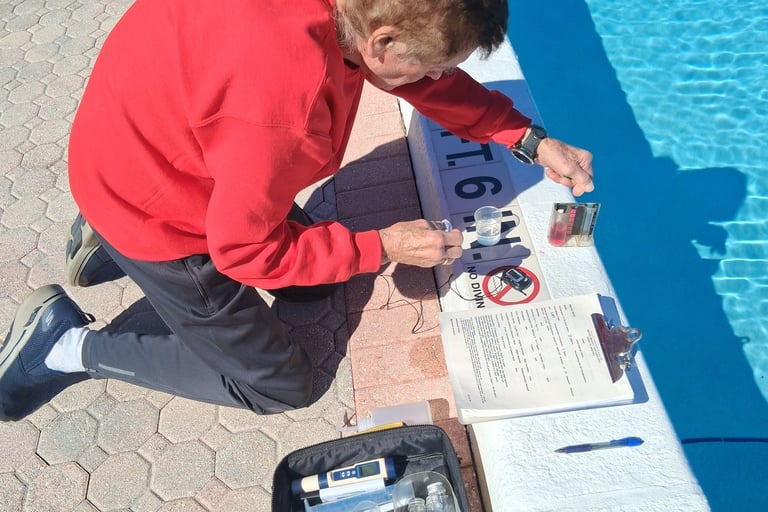
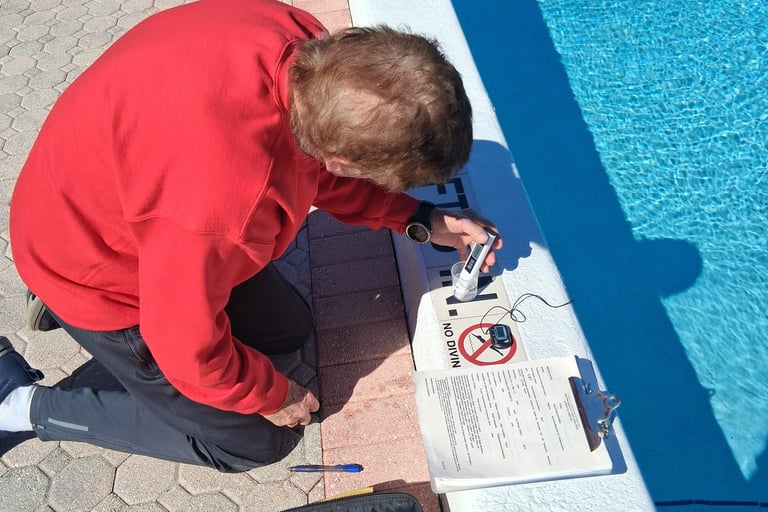
In the above photos we testing the pool water for pH, chlorine, alkalinity, hardness, salt, and temperature.
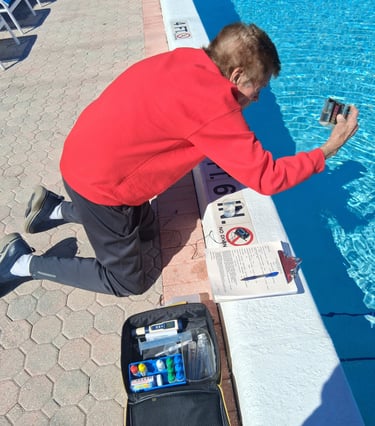
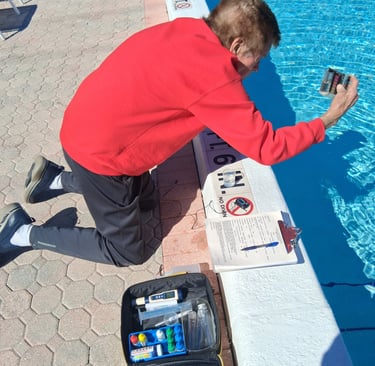
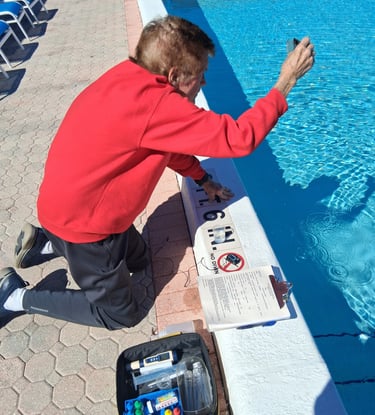
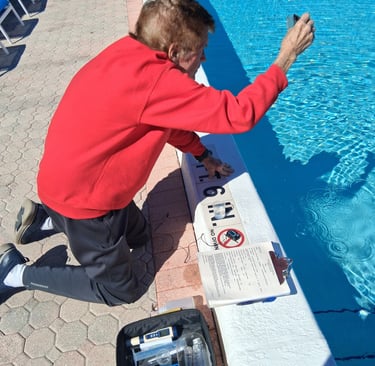
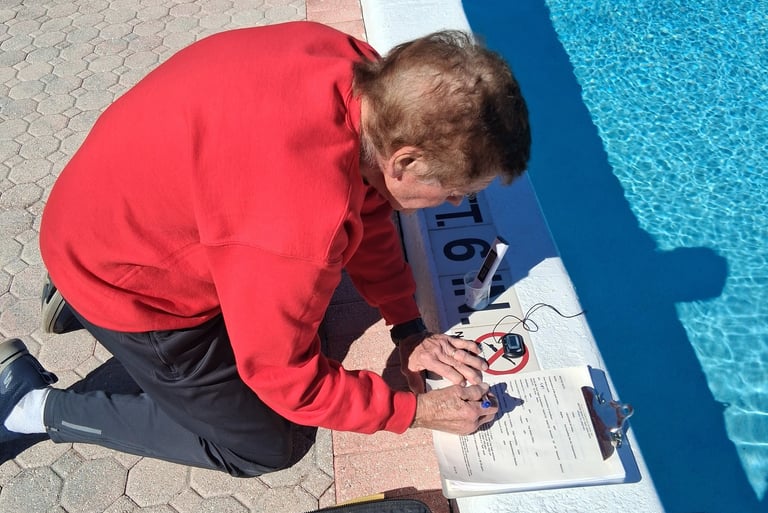
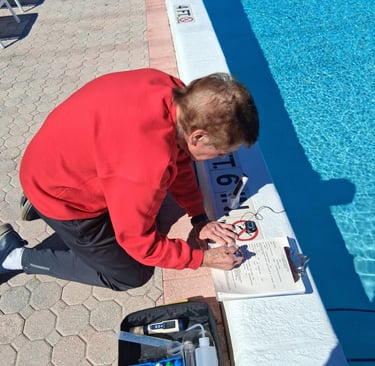
The color changes when the water chemistry is at the level. When it is determined, it is written on the Water Quality Test Analysis Results (WATAR). This report is then sent to the pool owner.
MAINTAINING GOOD QUALITY WATER IN YOUR POOL
Things to do:
DAILY:
· Check the chlorine (Cl2) level to be sure it is about 1.5 ppm. Use a OTO (Orthotolidine) and look at the color. Put pool water into 1/2 of a test tube level. Place 1 drop of OTO into it and mix it. If the color is a a middle yellow the Cl2 is good. If the chlorine level low or no color it is too low, critters and algae will grow, and the water may suddenly get cloudy and the pool will smell. If the OTO is orange the Cl2 it too high.
· Check the pH of the water. The test kit has phenol red to do this. Place a single drop of Phenol Red into 1/2 test tube of pool water. If the phenol red turns orange the pH is good.. If it turns yellow the water is too acid (high pH) and it will corrode parts of the pool plumbing. If it turns red pink the water is too alkaline and the chlorine will not kill bacteria as effectively and you will notice a chlorine smell in the pool area.
· Check the temperature of the water to be sure the heater is doing the proper job.
WEEKLY:
· Check the water level in the pool to maintain it ½” below the top of the propulsion assembly.
· Check the filter basket and remove any debris that has accumulated. Air should not get into the skimmer and inside the pool pipes.
MONTHLY:
· Vacuum the pool. It would need it more often if the pool is outdoors
· Check the filtration pressure. When it reads 5 psi higher than the initial reading it is time to clean it.
· Do a leak check. You should check at the area on the pool bottom. You should check what the pool surface level is.
YEARLY:
· Remove the front grill and clean it.
· Remove bottom grill in propulsion unit and clean it.
· Check all screws for tightness.
· Check hydraulic oil for viscosity.
Assuming now a familiarity with basic Water Chemistry terms we recommend doing the following in the order listed:
1) Balance Total Alkalinity. We recommend a Total Alkalinity of 120 parts per million ("ppm"). Raise Total Alkalinity by adding Sodium Bicarbonate (baking soda). Lower Total Alkalinity by adding either Muriatic Acid or Sodium Bisulfate. Included with your pool kit are containers of Sodium Bicarbonate (Alkalinity Plus) and Sodium Bisulfate (lowers pH). Follow directions on the containers keeping in mind that an Endless Pool contains 2,500 (some over 3,000 with deeper pool) gallons of water. Always add chemicals to the pool with the swim current running to ensure even distribution. Add less than you think necessary, wait a few hours and test again. Write down how many tablespoons you added, and the results of the following tests using the test log provided.
2) Balance Calcium Hardness. We recommend a Calcium Hardness of 180 ppm. Raise Calcium Hardness by adding Calcium Chloride. A container of Calcium Chloride was provided with your pool. As with all chemicals add less than you think necessary, wait a few hours and test again. Write down how many tablespoons you added and the results of the following tests using the test log provided.
3) Balance pH. We recommend a pH level of 7.2-7.5. Raise pH with Sodium Carbonate (levels pH) and lower pH with Sodium Bisulfate (lowers pH). Note that you lower pH with the same chemicals used to lower Total Alkalinity. This is important and often confusing. Always adjust Total Alkalinity first before considering pH. If you are having trouble balancing your pH after correcting your Total Alkalinity, please consult Deep-Six (845-255-7446).
4) In the beginning, 'Shock' the pool by adding 2 cups of regular unscented bleach with the pool swim current running. Bleach is a dilute solution of sodium hypochlorite (5%) and is the most effective and most economical way to oxidize your pool. We recommend maintaining 1.5 to 2.0 ppm Free Chlorine in your pool at all times. If the liner is slippery, brush the liner with the vinyl liner pool brush provided first before shocking the pool. A slippery liner is an indication of algae growth and means that some additional chlorine above your normal dosage is required.
5) After 24 hours of the first operation of the filter following the addition of bleach, bleed off air at the filter and note the pressure on test log sheet. If the pool has been contaminated with construction debris during installation, you may wish after 24 hours to exchange or clean the cartridge filter. Review pump and filter literature before doing this. Typically, the cartridge should be removed and replaced when the filter pressure rises 5 psi above starting pressure. In indoor installations and with light to moderate use, this may be only once every few months. The filter pressure should be checked weekly.
6) Water Chemistry monitoring and adjustment can now be done every few days with an emphasis on chlorine and pH. It is critical for the long life of your equipment that these stay within range Although as important, Total Alkalinity will fluctuate less frequently and needs to be checked approximately every two weeks. Calcium hardness will change slowly over time and need only be checked every month or two.
Please be sure to read the Nature2 literature regarding the necessity of chlorine and oxidation in your water, Your copper/silver purification system will disinfect the pool water but it will not “burn out" small particles which can both cling to the liner causing slipperiness or make the water cloudy. We recommend getting into a routine that involves adding a measured amount of chlorine bleach either every time you swim as you leave the water, or at the very least every 3 days. This measured amount depends on pool use. One person swimming every day for 30 minutes might add 1/2 cup after each swim. This small amount will not be noticeable and will maintain the required 1.5 to 2.0 ppm chlorine residual. Heavier use and use by children generally require more chlorin
If the pool heater does not raise the water above the air temperature, check if the electrical circuits are working properly. Call Deep-Six (845-255-7446) if problem. This is not the heater located high on the pool wall. A common problem with the electric heater is the adjustment of the pressure switch. The pressure switch arrives preset by the manufacturer; you must verify that this setting is correct. The pressure switch is part of the safety circuit on the heater. When the pump turns on, the pressure switch senses water pressure, allowing the heater to turn off! When the pump turns off, the water pressure drops, triggering the pressure switch to turn off the heater. You must verify that the heater turns off when the pump turns off! If the light on the heater does not turn off when the pump does, the pressure switch is being activated by static water pressure and needs adjustment.
Floating Thermal Cover: Endless Pools, Inc. provides a lightweight cover for the Endless Pool. This cover floats on the water surface, insulating the pool while preventing evaporation. Consistent use of this cover will keep the water cleaner, save energy, and keep the room dry. The cover should be completely removed from the water before the machine is used.
dsddd
845-255-7446
© 2025. All rights reserved.